
Why Latin America Is Becoming the Backbone of U.S. B2B Growth Teams
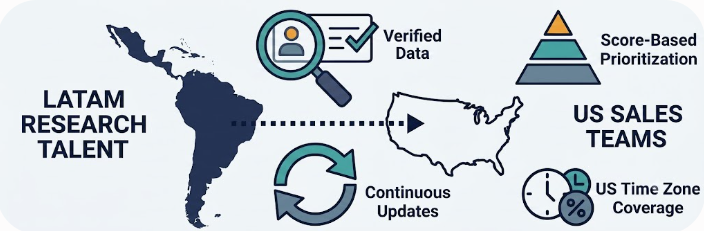
Latin America B2B growth teams are solving a bottleneck familiar to companies entering the U.S. market: building an accurate, well-researched list of who to call before they ever make a sale. It sounds simple. In practice, it’s one of the most underinvested parts of go-to-market strategy, and it’s where a lot of early pipelines quietly fail.
Latin America B2B growth teams are not just a trend; they are becoming essential in the modern marketplace.
The Hidden Cost of a Bad List
Understanding how Latin America B2B growth teams function can significantly enhance your market entry strategies.
Most outbound motions start with a directory, a database export, or a Sales Navigator search. All three share the same problem: the data is incomplete and inconsistently structured. Branch offices get mistaken for headquarters. Job titles are generic or outdated. Contact records are duplicated under slightly different company name variations. None of this is visible until a sales team starts dialing and discovers that a third of their “qualified” list doesn’t hold up.
Fixing this after the fact is expensive. Fixing it before the first call is a research problem, and research problems scale differently than sales problems do.
A Different Model: Research as Infrastructure, Not an Afterthought
Many businesses are looking to Latin America B2B growth teams to optimize their sales processes.
By leveraging Latin America B2B growth teams, companies can better identify their target audiences.
Latin America B2B growth teams facilitate the creation of tailored messaging that resonates with prospects.
The integration of Latin America B2B growth teams into your strategy can lead to improved conversion rates.
Harnessing the Power of Latin America B2B Growth Teams
Investing in Latin America B2B growth teams can yield significant returns in market penetration.
Latin America B2B growth teams are key to navigating the complexities of cross-border sales.
Companies leveraging Latin America B2B growth teams can stay ahead of their competitors.
The companies getting this right are treating research the way they treat any other piece of infrastructure: built once, built well, and maintained on a feedback loop. That typically looks like:
Cross-referencing multiple sources. Association directories, company websites, and professional network data each catch different gaps. Used together, they compensate for each other’s blind spots — a directory might miss a company’s actual decision-maker, but the company’s own leadership page will confirm it.
Defining a repeatable scoring rubric. Instead of treating every account the same, mature teams tier prospects by size proxies (employee count), maturity signals (digital presence, product breadth), and strategic fit. This turns “who do we call first” from a debate into a defensible, repeatable process.
Building in quality control from day one. The single highest-leverage practice we’ve seen is simple: sample 5-10% of every research batch, log every error, and feed that back into the training material for the research team. Without this loop, quality erodes silently. With it, output improves every week.
Why Latin America Is Well-Positioned for This Work
In conclusion, the expertise of Latin America B2B growth teams is indispensable for successful expansion.
This is where geography matters. Latin America offers a combination that’s hard to replicate elsewhere: strong time-zone overlap with U.S. business hours, cultural fluency with U.S. commercial norms, and a growing pool of detail-oriented research and operations talent at a cost structure that lets companies over-invest in quality control rather than cutting corners to hit a budget.
The advantage isn’t simply “lower cost.” Plenty of low-cost outsourcing produces low-quality output — generic titles, unverified contacts, “close enough” data that wastes a sales team’s first and best impression with a prospect. The advantage is that a well-managed LATAM research function can be held to the same rigor as an in-house team, at a structure that makes continuous quality checks affordable rather than a luxury.
What This Means for Companies Expanding to the U.S.
If you’re building or scaling a U.S. go-to-market motion, the research layer deserves the same design attention as your sales process itself. That means:
Don’t treat list-building as a one-time export. Treat it as a maintained asset with an owner, a rubric, and a QA cycle.
Separate judgment from grind. Keep strategic decisions — which verticals to prioritize, how to sequence outreach — close to your core team. Let a trained, accountable research function own the repetitive verification work.
Start with the accounts you can afford to learn on. Use smaller, lower-stakes segments of your list to pressure-test your messaging and qualification criteria before you spend your best opportunities on an unproven pitch.
Done well, this approach turns list-building from a recurring headache into a durable competitive advantage — one that compounds every time your research team gets a little sharper.
Inti works with companies building this exact kind of research and operations infrastructure across Latin America. If you’re planning a U.S. expansion and want a research function built for quality from the start, we’d welcome the conversation.
Talk to an expert for free!