
Nearshore ERP and Data Talent: Why Latin America Is the Smart Choice for Your Next Migration Project
When companies plan an ERP migration or a major data initiative, the conversation usually starts with software and ends with budget. The factor that actually determines success — the people leading the work, especially nearshore talent Latin America — often gets decided last, and decided poorly.
Latin America has quietly become one of the strongest talent markets in the world for exactly this kind of work, particularly nearshore talent Latin America. And most North American companies are still overlooking it.
For companies looking to enhance their projects, nearshore talent Latin America offers unparalleled advantages in terms of skills and proximity.
Why Choose Nearshore Talent Latin America for Your ERP Needs?
The complexities of ERP migration go far beyond software compatibility and budget considerations. Successful migration hinges on the skills and experiences of the project team.
A project lead who has experience with a specific ERP system can navigate through potential pitfalls more effectively, ensuring that the project stays on track and within budget. To truly leverage the potential of ERP systems, companies must focus on assembling a team that not only understands the technical aspects of migration but also possesses stro
Leveraging Nearshore Talent in Latin America for Competitive Advantage
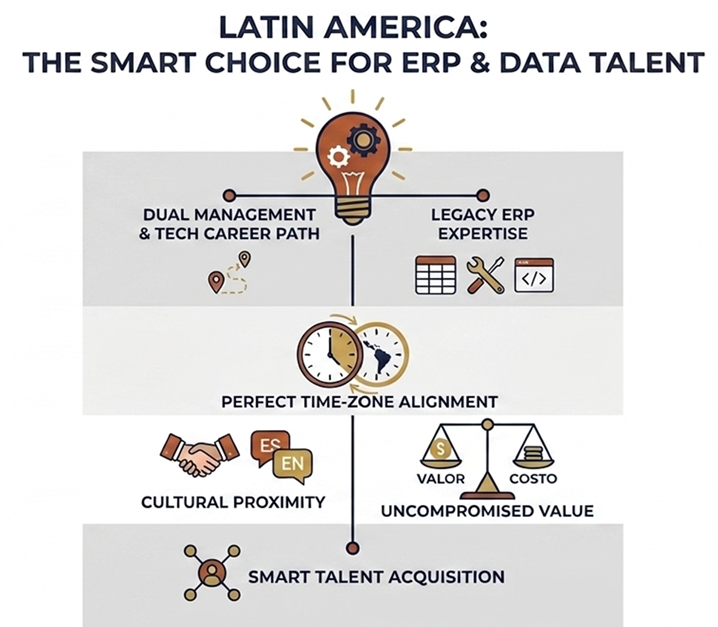
Latin America’s technology workforce didn’t start with startups. For decades, the region’s banks, insurers, manufacturers, and service companies ran on enterprise systems — and the professionals who implemented, customized, and maintained those systems are still working. Many began as programmers in the 1990s and 2000s and grew into technical leads and project managers. That career arc produces something rare: leaders who can run a steering-committee meeting in the morning and review SQL in the afternoon.
The region also boasts a rich variety of educational backgrounds and professional experiences, providing businesses with a wide range of perspectives and innovative solutions, particularly through nearshore talent Latin America. The collaborative nature of Latin American culture fosters strong teamwork and communication — key components for the success of any migration project.
A Burgeoning Tech Ecosystem
Cities such as São Paulo, Buenos Aires, and Medellín continue to nurture a new generation of tech-savvy professionals. These individuals are not only well-versed in programming languages and data analytics but are also trained in agile methodologies, which can significantly enhance project efficiency.
Deep Expertise in Legacy Systems
Legacy ERP migrations demand specific expertise that is often hard to find. In Latin America, professionals possess a wealth of historical knowledge about legacy systems that other regions may lack. Many consultants have firsthand experience working with systems that have been in use for over two decades. Their understanding of how these systems have evolved and what common challenges arise during migration can streamline processes and reduce the likelihood of setbacks.As more companies turn to nearshore talent Latin America, the demand continues to grow, making it a strategic choice for many organizations.
Professionals in the region have also had to navigate diverse regulatory environments and market dynamics, which has honed their problem-solving skills. They are adept at customizing solutions that meet unique local needs while adhering to global standards — a blend of local knowledge and international experience that makes them invaluable assets during ERP migrations.Industry leaders are increasingly recognizing the benefits of utilizing nearshore talent Latin America for specialized knowledge.
Industry-Specific Knowledge
Many Latin American specialists bring not only technical expertise but also industry-specific knowledge. A company can hire an ERP consultant with experience in their specific sector, whether it’s finance, healthcare, or manufacturing — ensuring that the migration addresses all necessary compliance and operational requirements
The Practical Advantages of Nearshore Engagement
Time-Zone Alignment
Teams across Latin America work the same business hours as the US and Canada. Daily standups, client presentations, and urgent escalations happen in real time, not overnight.
Cultural and Language Proximity
For companies operating in Latin America, or migrating systems that hold Spanish-language data, regional consultants eliminate an entire layer of translation risk. When a project manager in Latin America understands the nuances of American business practices and communication styles, they can tailor their approach to align with expectations more closely, leading to better collaboration and project outcomes.
Engaging nearshore talent Latin America allows for greater flexibility and adaptability in project execution.
Flexible Engagement Models
Senior Latin American professionals increasingly work as independent consultants, available by the hour or by the month. A company can engage a senior project leader for 40–80 hours a month — enough to lead a migration workstream — without a full-time hire. Whether a company needs a full-time consultant for a few months or part-time support over several years, Latin American professionals can provide tailored solutions that meet those specific requirements.
With nearshore talent Latin America, businesses can achieve high-quality outcomes without compromising on costs.
Cost Without Compromise
Hourly rates for senior specialists in the region are typically a fraction of equivalent US rates, with no discount on experience.
How to Structure a Nearshore Engagement That Works
The most effective model pairs a senior nearshore lead with hands-on technical resources. The lead owns scope, client communication, status reporting, and quality; an analyst or engineer does the day-to-day execution. This structure keeps senior time focused on judgment and keeps budgets lean.
Start with a Paid Discovery Phase
Smart companies begin with a short paid discovery — typically two weeks — to scope the work, assess data quality, and produce a realistic estimate before committing to a full project. The right nearshore lead makes that discovery dramatically more accurate, because they’ve seen the systems before.
This approach avoids costly mistakes associated with inadequate planning. By conducting thorough assessments during the discovery phase, clients can better understand their unique challenges and establish a clear roadmap for their migration efforts.
Build for Adaptability
The challenge isn’t whether this talent exists — it’s that the best people aren’t on job boards. They’re employed, selective, and found through trusted networks.
Companies should consider building long-term relationships with local partners who specialize in talent sourcing. This approach not only helps in identifying top talent but also fosters a supportive ecosystem where knowledge and resources are shared. By prioritizing partnerships over transactional relationships, companies can create a sustainable talent pipeline that benefits all stakeholders involved.
Work With Inti to Staff Your Next Migration
Inti connects companies with senior Latin American operations, technology, and project leadership talent — and helps structure engagements that work for both sides. If you’re planning a migration, a data project, or an expansion into the region, talk to us before you staff it. Find us at https://inticonsultingservices.com/
Talk to an expert for free!