
Why More Global Companies Are Building Their Latin American “Center of Excellence” Instead of Outsourcing It
Introduction
When a U.S. or global company acquires or expands a business unit in Latin America, it usually inherits more than new revenue — it inherits a set of local systems, habits, and reporting practices that don’t automatically line up with global standards. Finance doesn’t consolidate cleanly. IT infrastructure doesn’t map to the parent company’s stack. And nobody at headquarters has the on-the-ground context to explain why.
The traditional fix has been to fly in outside consultants for a few weeks, produce a report, and leave. It rarely works, because it treats local complexity as a problem to be solved remotely rather than understood from the inside.
The Center of Excellence Model
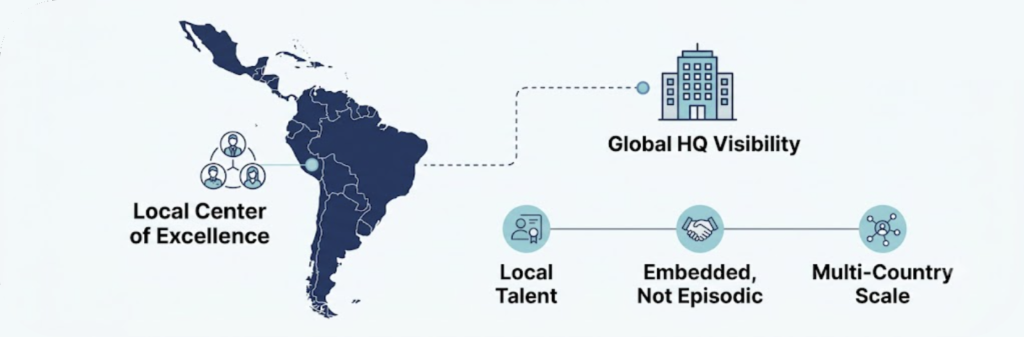
An increasingly common alternative is building a genuine local Center of Excellence: a team of Latin American finance, IT, and operations professionals embedded in the region, working as an extension of the global organization rather than an outside vendor. This model is built on three ideas:
Local talent, not just local labor. Latin America has a deep bench of finance leads, data specialists, and operators who understand not just the technical work but the business culture, regulatory environment, and market dynamics of their country. That context is difficult to replicate from outside the region.
Embedded, not episodic. Rather than a one-off audit, the team works alongside the acquired or expanding business over time, building trust with local staff and steadily improving how data and operations flow back to global leadership.
Built for corporate-scale complexity. This approach is particularly valuable for mid-size and large companies managing multi-country operations, where financial consolidation, reporting standardization, and technology integration are ongoing challenges rather than one-time projects.
A Representative Case
Consider a global company that acquired a business with a significant presence in Colombia. Leadership needed to understand why the acquired entity’s financials weren’t consolidating properly with global reporting — a common but costly problem after any cross-border acquisition. Rather than sending in a generic consulting team, the right approach was pairing a local finance lead with a local IT specialist who could jointly trace the data issues at the source, understand the systems already in place, and build a bridge to global reporting requirements. Within weeks, leadership had the visibility they needed to make decisions — with a team that would remain in place to sustain it.
Why This Matters Now
Two forces are converging to make this model more relevant than ever. First, more global companies are actively investing in or acquiring businesses across Latin America, drawn by growth and cost advantages — and running into the same integration challenges. Second, the rise of AI and automation in finance and operations means companies now need local partners who can not only navigate legacy systems but also help modernize them.
Companies that treat Latin America as a strategic market — worthy of real local leadership, not just back-office support — are the ones building operations that scale. The talent is there. The opportunity is building the right structure to use it.
Conclusion
If your organization is investing in, acquiring, or expanding across Latin America and needs a trusted local partner to lead on finance, IT, or operational integration, building a dedicated Center of Excellence is one of the highest-leverage investments you can make.
Talk to an expert for free!