
Tax Strategy as a Growth Lever in Latin America
Pablo Ramirez
Cesiah Martinez
Diego Montes
Latin America keeps offering strong growth opportunities, but the “how” matters as much as the “where”. Companies should treat tax, trade, and operating model design as one integrated decision tied directly to cash flow, risk, and speed to market.
Four themes drive the most consistent outcomes:
- Cross-border structure and compliance with Transfer Pricing regulations.
- Incentives for Free Trade Zones, International Service Centers, and other benefits in certain jurisdictions.
- Centralized finance and tax operations.
- Trade and tariffs as a strategic lever.
- Strategic management of VAT and indirect taxes.
1) Build the structure first with transfer pricing strategies
For multinationals operating across Latin America, tax efficiency starts with structure. Transfer pricing and related-party contracting often become the largest levers because they shape where profits land, how costs are allocated, and how cash moves back to the parent company.
From an executive perspective, the goal should not only be to achieve tax benefits, but also to reach predictable margins while always taking into account compliance with formal and/or substantive obligations, in order to avoid tax risks before the corresponding Tax Authorities.
What strong programs typically include:
- A clear intercompany model (services, trading, IP, financing) tied to value creation.
- Documentation that matches how decisions are made and where execution happens.
- Governance that prevents aggressive structures from creating audit exposure later.
- Understanding of local and regional complexities.
In commodities and cross-border trading, this is even more critical because regulators are especially sensitive to hidden costs, lack of substance, and misaligned pricing between related parties.
2) Use free trade zones to improve ROI without creating fragility
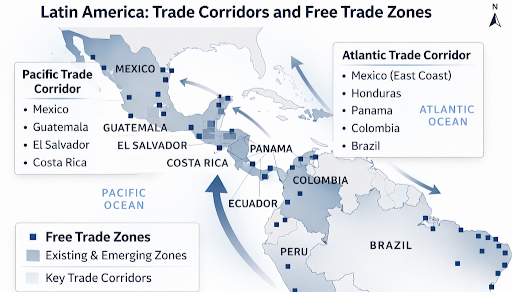
Many leaders still associate Free Trade Zone programs with manufacturing and maquila models, yet in several markets they can also support service operations and regional hubs.
Common benefits can include:
- 100% exemption from corporate income tax for the first 10 years.
- Exemption from municipal taxes for 8 or more years in certain jurisdictions.
- 0% VAT on qualifying local purchases and imports for all time operation..
- No customs duties on equipment and operational inputs.
- No withholding tax on certain payments abroad.
- The only tax charge during the operation for foreign partners is the withholding of dividends.
The key here is to navigate the rules accordingly. There are many caveats to how to achieve these incentives, and they are available in multiple LATAM countries.
3) Centralize finance and tax work where scale exists
For companies spanning multiple Latin American markets, shared services can reduce cost and improve control. Instead of staffing full finance and tax capabilities country by country, a regional model can consolidate reporting, compliance coordination, and process ownership while keeping local legal support where required.
This approach tends to create value through:
- Lower fixed cost and less operational duplication.
- More consistent reporting standards across countries.
- Faster decision-making because leaders have one consolidated view.
This is often most attractive in smaller markets where building full local teams is expensive relative to business size.
4) Treat trade policy and tariffs as a strategic lever
Tariffs and trade policy shifts are now directly influencing where companies manufacture, assemble, and source critical components. When tariff pressure rises, leadership teams usually face three options:
- Absorb the cost and lose competitiveness.
- Reconfigure sourcing and logistics.
- Shift specific value-add steps to a new location to change the economics.
This is where Latin America can create advantage, especially when companies move beyond “country selection” and into execution details such as:
- Supplier localization for critical components rather than relocating full production immediately.
- Rules-of-origin planning that is compliant and operationally realistic.
- Market entry strategies designed around how products and services will be classified, imported, and sold.
Following a structured way to navigate US tariffs will be important in this new age of de-globalization.
5) Strategic Management of VAT and Indirect Taxes
In Latin America, indirect taxes (VAT, ICMS, gross turnover taxes, among others) represent a substantial portion of the overall tax burden.Strategies include:
- Optimizing input VAT credits.
- Efficient management of tax carryforwards and recoverable balances.
- Reviewing supply chains to minimize tax cascading effects.
- Automating digital tax compliance (electronic invoicing and real-time reporting).
In Brazil, for example, the complexity of state-level ICMS requires advanced logistical and contractual planning to mitigate tax contingencies.
Sector notes that illustrate how these themes show up
Energy tends to be heavily regulated, especially closer to the wellhead, and many large operators already run mature structures governed by global auditors. The practical opportunities often sit in downstream distribution models, services ecosystems, and targeted tax and compliance support that aligns with local regulation.
In manufacturing, Mexico continues to attract shifts from Asia and other continents when companies can build a supplier map that replaces the most tariff-sensitive or lead-time-sensitive components first, rather than attempting a full relocation in one move.
In chemicals and consumer goods, total landed cost can still favor Asia even when regional supply exists, which elevates the importance of correct product classification, origin documentation, and logistics design.
Also, in high-inflation economies such as Argentina, tax strategy must address:
- Inflation-adjusted tax mechanisms.
- The tax impact of foreign exchange differences.
- Structuring of intercompany financing.
- Protection of working capital against nominal taxation on inflation-eroded real results.
What Executives should do next:
For leaders managing Latin America exposure (or planning entry) the following actions create immediate strategic clarity:
- Build a country-by-country “value map”
Combine incentive eligibility, tax risk, trade agreements, logistics cost, and talent availability. - Pressure-test transfer pricing against substance
Ensure operating reality, decision rights, and documentation match the model. - Evaluate Free Trade Zones for service operations
Shared services, call centers, and regional hubs may qualify depending on jurisdiction. - Create a tariff response playbook
Identify which products, inputs, and routes drive exposure—and what operational changes are realistic in 6–12 months. - Design a scalable governance model
Shared services and centralized oversight reduce risk and make regional growth repeatable.
Conclusion
In Latin America, tax strategy is not a back-office exercise, it is a critical function for any global company. If you are interested in learning more about the tax strategies applied to specific countries, we have the tax/fiscal experts that can help you think through your current situation.
Talk to an expert for free!