
Operating in Latin America and the Caribbean: What Investors and Operators Need to Know About Risk, Talent, and Capital
The Opportunity Behind the Headlines
Latin America and the Caribbean continue to attract international capital into infrastructure, energy, and manufacturing — often through multilateral-backed programs designed to de-risk early investment in frontier markets. But the gap between an attractive opportunity on paper and a project that actually gets delivered safely and profitably usually comes down to a handful of operational realities that don’t show up in the headline numbers.
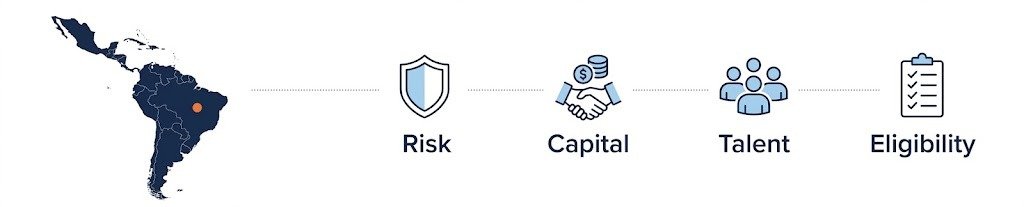
Price Risk Honestly, Not Just Capital
It’s tempting to evaluate a regional opportunity purely on projected returns or contract value. In practice, the cost of operating safely in a high-risk market — armored transport, private security, non-commercial logistics routing, contingency time for disrupted access — can rival or exceed the nominal value of the underlying asset. Any serious evaluation needs a real security and logistics budget built in from day one, not treated as an incidental travel expense. Skipping this step is one of the most common reasons international teams walk away from otherwise viable projects mid-stream.
Payment Structures Should Match Risk Exposure
Standard milestone payment structures — a small deposit, a mid-project payment, and a large final payment — are built for low-risk, predictable environments. They break down in markets where mobilization costs are high and the operating environment is unpredictable. Investors and operators serious about the region should expect, and negotiate for, advance payment structures that scale with actual risk exposure rather than defaulting to whatever template the RFP originally included. Multilateral funding sources, in particular, often have more flexibility here than their initial documentation suggests.
Talent Is the Real Bottleneck, Not Capital
Capital access has become easier across the region as multilateral and private financing programs have matured. What remains scarce is experienced local talent: teams who understand both the technical requirements of a project and the on-the-ground realities of operating in that specific market. International investors who partner with regional operators to build and retain this talent — rather than importing outside teams for every project — consistently see better delivery outcomes and lower long-term risk.
Eligibility Rules Aren’t Always Fixed
Public and multilateral-funded RFPs frequently include eligibility criteria, such as minimum years of corporate experience, that can disqualify strong, capable regional teams on a technicality. Before assuming a project is out of reach, it’s worth asking directly whether joint ventures, subcontracting arrangements, or consortium structures can be used to meet the stated requirements. Many funding bodies are more flexible on structure than the written criteria suggest, particularly when the underlying technical capability is strong.
Why Local Partners Change the Equation
The common thread across all of these considerations is that success in Latin American and Caribbean markets rarely comes down to capital alone. It comes down to having a partner on the ground who can price risk accurately, structure payment terms appropriately, assemble the right talent, and navigate eligibility requirements creatively. For companies and investors evaluating opportunities in the region, that local operating expertise is often the difference between a project that looks good in a proposal and one that actually gets built.
Talk to an expert for free!