
Why Latin America Is Becoming the Testing Ground for AI-Driven Operations
For years, the pitch for building operations in Latin America was almost entirely about cost: strong talent at a lower price point than the US or Western Europe, in time zones that overlap with North American business hours. That pitch is still true. But it’s no longer the most interesting reason to be paying attention to the region.
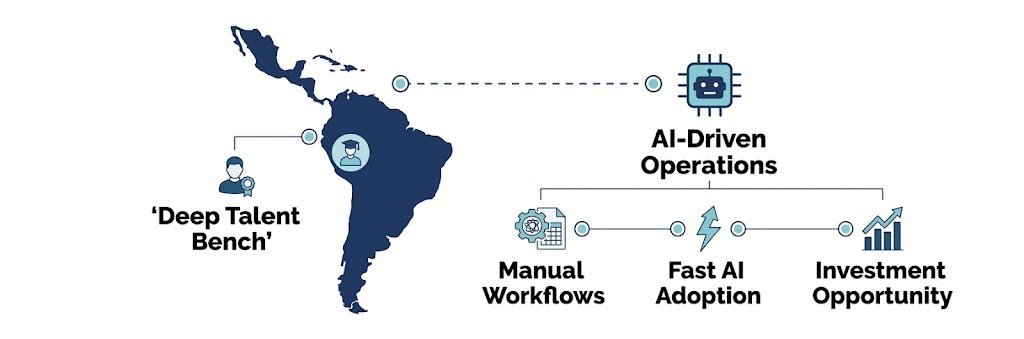
What’s changed is that the same AI tooling that’s reshaping operations, sales, and data work everywhere else is landing in Latin America at a moment when the region already has an unusually deep bench of technical and operational talent — and a lot of mid-market and enterprise businesses still running core processes on manual, spreadsheet-driven workflows. That combination — strong talent, real operational gaps, and rapidly cheaper AI tooling — is what makes the region worth watching right now, for operators and investors alike.
The Talent Story Is No Longer Just About Cost
Nearshore talent in Latin America has matured well past the “cheaper developers” narrative. The region now produces strong data engineering, AI implementation, and analytics talent that can operate at a fraction of the fully loaded cost of equivalent talent in the US, without the time zone friction that comes with offshoring further afield. For companies building AI-enabled products or running AI-driven internal transformations, that talent pool is a genuine structural advantage, not just a budget line.
Where the Operational Gaps Actually Are
Talk to operators across manufacturing, distribution, and mid-market services companies in the region, and a consistent picture emerges: strong commercial relationships and real market share, sitting on top of operations that still run on manual processes, disconnected systems, and institutional knowledge that lives in a handful of people’s heads rather than in any system of record. Sales outreach is often still relationship- and network-driven rather than data-driven. Prospect and customer databases are frequently large but messy — inconsistent fields, duplicate records, and little enrichment — which makes it hard to run a modern, targeted go-to-market motion even when the will to do so exists.
This is precisely the gap AI-enabled operations tooling is built to close: cleaning and structuring commercial data at a scale no manual team could match, formalizing outbound sales processes that used to depend entirely on personal networks, and giving leadership real visibility into pipeline and account health instead of anecdotes.
Adoption Is the Real Bottleneck, Not Technology
The technology to do all of this now exists and is genuinely inexpensive relative to a few years ago. The harder problem is organizational: internal IT functions in many LatAm companies remain cautious or slow to adopt new tooling, and change management — getting a sales team or an operations team to actually trust and use a new AI-driven workflow — is consistently the longest pole in the tent, longer than any technical implementation. Companies and investors underestimating this adoption curve tend to overestimate how fast an AI transformation will actually show results.
The Investment Case
For investors evaluating opportunities in the region, the thesis is straightforward: the talent required to build and run AI-enabled operations is already in place and priced attractively; a large share of the addressable market — mid-market distributors, manufacturers, and services businesses — has not yet modernized its core operating processes; and the tooling gap that used to make this transformation expensive has closed dramatically. The businesses and platforms that combine credible local operating experience with real AI implementation capability are positioned to consolidate categories that have historically been too fragmented and too manual to attract serious capital.
What Comes Next
Latin America won’t leapfrog into AI-native operations overnight — adoption curves inside individual companies will remain the gating factor for the next several years. But the direction is clear: a region with deep, cost-effective talent and a long list of operationally under-invested businesses is exactly where AI-driven transformation tends to generate the most value per dollar invested. For operators and investors willing to do the harder work of change management alongside the technology, this is a genuinely rare window.

Talk to an expert for free!